The Hoglund Foundation
articles of interest


Newsroom

2008 - Math Program Adds Backers
2008 - World Affairs Council of Houston International Citizen of the Year
2007 - Partners Card, Celebrating 15 Years of Shopping, Saving Money & Saving Lives
2007 - Casa de Esperanza Newsletter: Capital Campaign Leadership
2006 - Philanthropy World Magazine: Profile of Sally and Forrest Hoglund
2006 - Dallas Historical Society: Philanthropy Award for Excellence
2005 - National Philanthropy Day Awards Luncheon: Foundation of the Year Award
2004 - Dallas Morning News Business Day – “Getting and Giving”
2001 - M.D. Anderson Conquest Magazine: Profile of Sally and Forrest Hoglund

Grant Highlights
2008 - Musuem Planners Get Busy
2007 - New wireless computer lab encourages higher level thinking, Reasoning Minds
2007 - Texas Scottish Rite Hospital for Children: Researchers Link First Gene to Scoliosis
2007 - Dallas Museum of Nature and Science: Project Report on New Facility
2006 - Reasoning Mind: The Dallas Morning News


2008 - Math Program Adds Backers

Math program adds backers

Reasoning Mind, the computer-driven program that enables school kids to master math at their own pace, is making great strides in the classroom and experiencing a cash boom from donors.

In July 2006, we told you about the program, which was invented by Dr. Alexander R. “Alex” Khachatryan, a Muscovite mathematician who came with his wife, Julia, and their son, George, to the United States in 1990 with only $700 to their names, three suitcases and 50 boxes of books.

The Soviet Union was disintegrating.

After teaching at Texas A&M University for a couple of years, Dr. Khachatryan and his wife started a petroleum consulting and information technology services company.

George didn’t adapt as well as his parents, and it occurred to Alex and Julia that if a product of an education-centric family like theirs was having problems, there must be millions of other children who needed help.

In 1999, Alex and Julia sat down with George to create Reasoning Mind, based on a Russian method of learning math.

“Students today prefer to learn and learn math best when complex information is delivered in an individualized way through the Internet,” Dr. Khachatryan said.

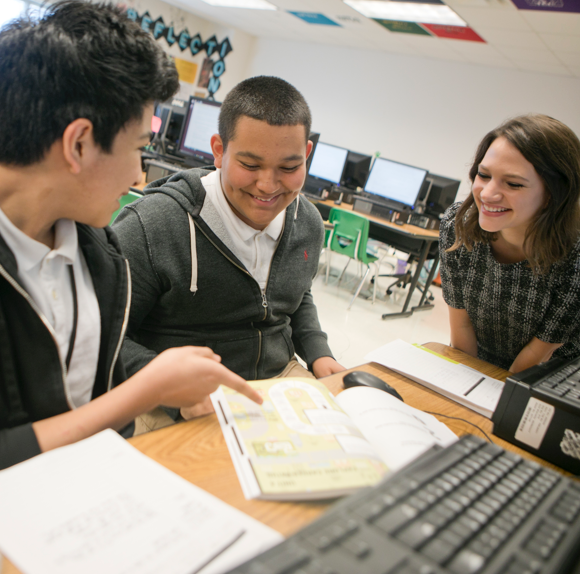
“Where it was not easy to implement, The Reasoning Mind model is simple. Students learn a self-paced, individualized math curriculum through interactive sessions delivered through the Internet. Teachers coordinate the class, integrating online work with traditional instruction.

The program is 21st century and ‘cool’ and engages students instantly,” he said.

“Each student’s program is monitored by the computer system and reported to teachers so that difficulties can be diagnosed early and learning progress can be tracked continuously.”

Expanding reach

In 2006, 12 schools had the Reasoning Mind program, and now there are 21 schools with a total of more than 1,500 students in the program, Dr. Khachatryan said.

J. Erik Jonsson Community School in Oak Cliff, which is under the supervision of the Salesmanship Club of Dallas, uses the program, as do schools in Arlington, Houston, Brazoria County and New Orleans.

The Jonsson Community School began in its current form in 1995 and serves 3-year-olds through fifth-graders, said Dr. Michael Murphy, director of education and professional learning for the Salesmanship Club Youth and Family Centers.

“Similar to our public school friends, three-fourths of our students qualify for free or reduced lunch,” Dr. Murphy said. “In education terms, this means they are considered at-risk in the same way one would talk about students from other urban schools.”

The school adopted Reasoning Mind this year, and only the fifth-graders currently use the program.

“J. Erik Jonsson Community School is grounded in innovation, and we are constantly looking for better ways to instruct our students and prepare them for success,” Dr. Murphy said. “Because of this, Reasoning Mind was a natural fit.”

“The program allows us to individualize for our students but still allows for teachers to pull small groups and maintain that personal relationship that is so critical to learning.

“We will continue to evaluate Reasoning Mind, but we believe it is adding tremendous value to our overall curriculum,” he said.

More subjects

The program can ultimately be adapted to other subjects, Dr. Khachatryan said, from physics, chemistry and biology to the humanities.

We mentioned Reasoning Mind’s “cash boom.”

Dr. Khachatryan and his family live in Houston, and the program has attracted backers from Houston and Dallas.

Houston businessman Ernest H. “Ernie” Cockrell is chairman of the program board of trustees. He recruited Forrest Hoglund to serve as vice chairman.

Mr. Hoglund and his wife, Sally, invented the 48-hour day. They need all those hours to take care of their business, civic and cultural interests in Dallas and Houston, where they split their time.

The Hoglunds and their foundation originally donated $1 million to Reasoning Mind, and they’ve since added $1.5 million to support the program.

After becoming interested in the program about two and a half years ago, Gerald McElvy, president of the ExxonMobil Foundation, added what Mr. Hoglund calls a “giant” boost to the program.

Mr. McElvy has committed more than $2 million from the foundation to help expand Reasoning Mind. What’s more, he’s thinking nationally and plans to look at the possibility of donating the program to the Washington, D.C., school system.

The Meadows Foundation has donated $250,000, and Jim and Judy Gibbs have given $50,000.

Some of the other supporters include the Houston Endowment Inc., Cockrell Foundation, Brown Foundation, Michael and Susan Dell Foundation, Harold Simmons Foundation, M.D. Anderson Foundation, the Hobby Family Foundation, and Alex and Julia Khachatryan.


>Download Article